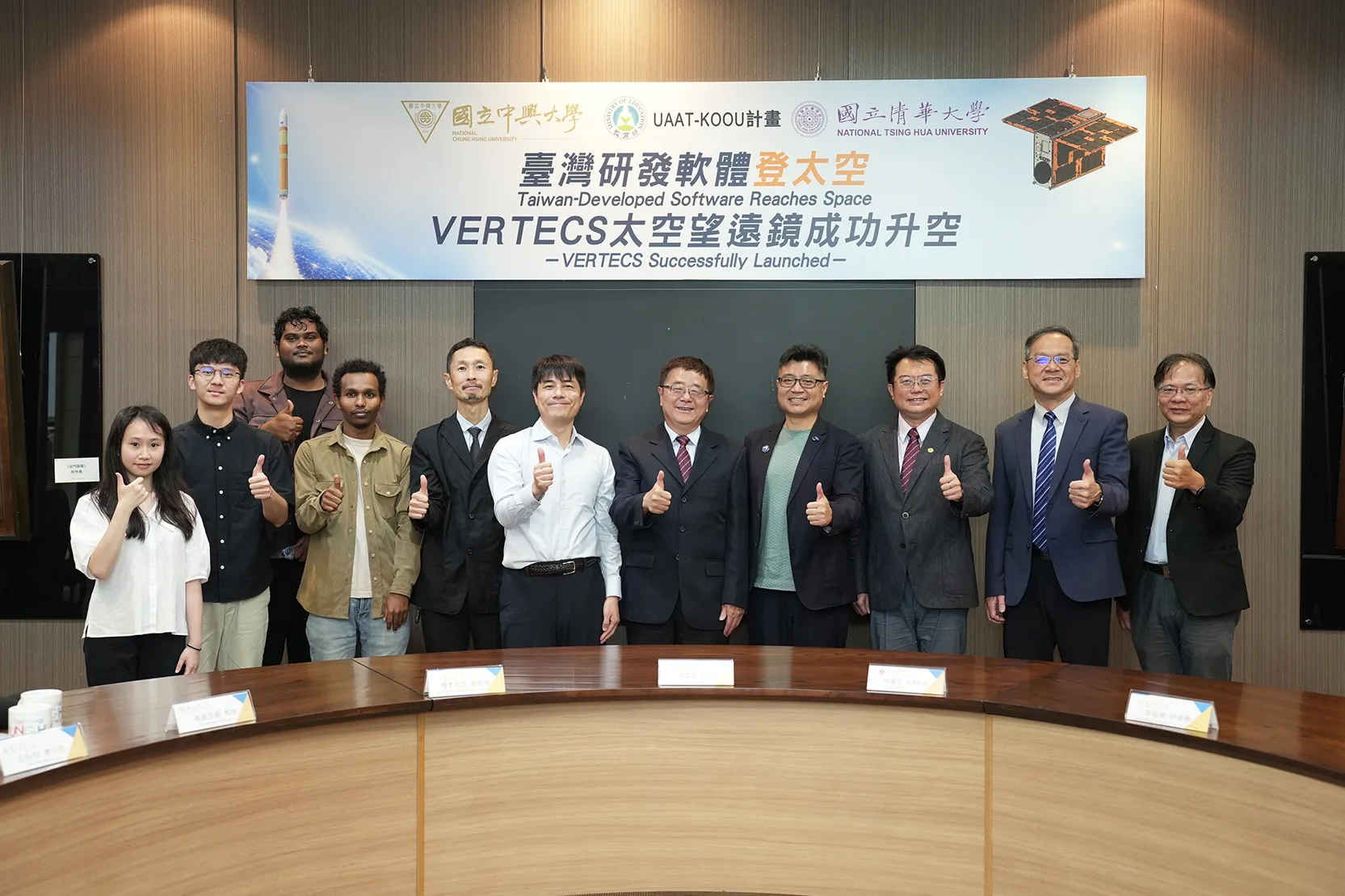
VERTECS (Visible Extragalactic background RadiaTion Exploration by CubeSat), a CubeSat space telescope co-developed by research teams from National Chung Hsing University (NCHU) and National Tsing Hua University (NTHU), launched successfully on June 12 aboard Japan’s latest H3 launch vehicle (flight No. 6). Led by the Kyushu Institute of Technology (Kyutech) and carried out in partnership with the Japan Aerospace Exploration Agency (JAXA) and 13 industry–academia–research institutions across Taiwan and Japan, the mission marks an important milestone for Taiwan’s academic participation in international space science.
The launch not only signals a new stage in Taiwan–Japan space technology collaboration, but also represents a key achievement of the Ministry of Education’s UAAT-KOOU program, “Space Technology Exploration and Data Science Applications.” NCHU Vice President for Research and Development Sung Chen-Ming, Deputy Director-General Tseng Hsin-Yuan of the Department of Higher Education at the Ministry of Education, NCHU Department of Physics Associate Professor Tetsuya Hashimoto, and NTHU Institute of Astronomy Professor Tomotsugu Goto witnessed the historic launch either remotely or in person in Japan. On June 25, NCHU held a results press conference chaired by President Chan Fu-Chih.
Exploring One of the Universe’s Greatest Mysteries
Scientists have long observed an “Excess Light” in the cosmic background radiation whose brightness far exceeds the total known light from galaxies. Its origin remains unexplained and is considered one of the major unsolved mysteries of modern astronomy.
Because Earth’s atmosphere is itself far brighter than the faint cosmic background radiation, high-precision observation requires a space-based telescope. With a wide field of view of 36 square degrees, VERTECS will spend the next year conducting the world’s most precise visible-light observations of the cosmic background radiation, aiming to provide key evidence for understanding cosmic evolution and the origin of the background light.
Taiwan’s Self-Developed Systems Reach Space
Notably, the mission’s data-reception system, along with its subsequent data-processing and calibration systems, all rely on software independently developed by the Taiwanese team. These systems successfully reached space aboard the satellite, demonstrating Taiwan’s research strength in space data science and satellite payload technology.
VERTECS is also the first space mission under the Ministry of Education’s integrated UAAT-KOOU program, “Space Technology Exploration and Data Science Applications.” Directed by Professor Lin Chien-Hung of National Cheng Kung University, the program brings together NCHU, NTHU, Kyutech, and Kyushu University to advance three CubeSat science missions and cultivate Taiwan’s next generation of space technology talent.
Cultivating Space Talent — Taiwan’s Youth in International Missions
NCHU President Chan Fu-Chih noted that the program’s greatest significance lies in giving faculty and students the opportunity to take part in international space missions. Through collaboration with international teams, students gain invaluable research and cooperation experience. Moreover, the data-reception, data-processing, and calibration systems used in this mission were all developed independently by the Taiwanese team, showcasing the nation’s R&D strength in space data science. He expressed hope that future observational results will offer more clues for humanity’s exploration of the universe.
Associate Professor Tetsuya Hashimoto of NCHU’s Department of Physics, principal investigator of the project, said: “It is truly exciting to see young Taiwanese students take part in an international space science mission and contribute to cutting-edge research. This is not only a scientific achievement but also an important outcome of Taiwan’s space talent cultivation.”
Co-principal investigator Professor Tomotsugu Goto of NTHU said: “VERTECS will observe the cosmic background radiation with the world’s highest precision. This is a crucial first step toward understanding the mysterious origin of the extragalactic background light, and will help humanity gain a deeper understanding of the formation and evolution of the universe.”
Deputy Director-General Tseng Hsin-Yuan of the Department of Higher Education said: “The VERTECS mission demonstrates the achievements of Taiwan’s higher education in international research collaboration. The Ministry of Education will continue to support space technology and the cultivation of key-technology talent, helping Taiwan’s youth reach the international space stage and raising our nation’s visibility and competitiveness in the global space technology arena.”
Following the successful launch, the research team will carry out satellite functional verification and preliminary observations, and plans to continue collecting cosmic background radiation data over the coming year as it works toward solving the mystery of the universe’s “Excess Light.”